


Premier Jiang Yi-huah (江宜樺) yesterday brushed aside concerns voiced by protesters about the cross-strait service trade agreement as he demanded that Cabinet members push ahead with the pact, saying it will bring the nation more advantages than disadvantages.
“Not only do its advantages outweigh the disadvantages, it is also crucial to the future of our economic development, which is what a responsible person must bravely do,” Jiang said in his address at the weekly Cabinet meeting as the protests that began on Tuesday outside and inside the Legislative Yuan continued.
Jiang made three demands of Cabinet members.
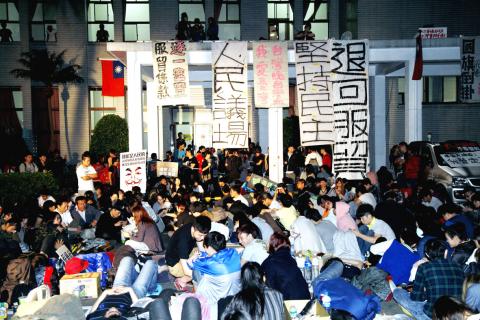
Photo: David Chang, EPA
The “first and foremost priority for” each government agency is to have the trade pact endorsed by the legislature before its current session ends in June, he said.
He urged the necessary agencies to communicate more effectively with the public to boost the support base for the trade pact to beyond the current 60 percent.
He asked the National Police Agency to take the appropriate measures necessary to assist the Legislative Yuan in a rapid resumption of order in the complex, without provoking serious clashes with protesters or inconveniencing lawmakers.
Given the controversy over the trade pact, each government agency must remain steadfast, showing the public how the government is continuing to work on policies to benefit the nation and its people, and show them the direction the nation is taking, Jiang said.
The concerns voiced by the protesters that the negotiations leading to the trade pact were opaque and the pact’s terms of trade would hurt the interests of Taiwan were “unnecessary,” he said.
The protesters’ perceptions of the pact were based on “groundless rumors” and “defamation,” Jiang said, blaming “certain media” for their “incorrect” coverage of how the pact would affect the country.
The government has completed all the preparations to liberalize the sectors covered under the pact since it was signed in June last year, Jiang said.
The policies and measures needed to assist local industries, such as laundries, hair salons, beauty centers and Chinese medicine dealers in upgrading their quality so they can become more competitive are ready for implementation, he said.
After months of effort, the associations of those industries that might suffer adverse effects after the pact is implemented have gradually come around to support the agreement, Jiang said.
The “certain political and social groups” behind the protesters should not try to use the situation for their own political gains because it would only damage the nation’s democratic system.
Meanwhile, Chinese Nationalist Party (KMT) caucus whip Lin Hung-chih (林鴻池) said the protesters’ occupation of the legislature’s chamber was apparently “instigated” by the Democratic Progressive Party (DPP) and other “ill-intentioned people” and that the KMT would never give in to their ultimatum.
“Democratic politics means that people make rational appeals by legal means. Democracy without the rule of law is nothing but chaos,” Lin said.
The presence of several DPP lawmakers inside and outside the legislature and the repeated calls by senior members of the party for the public to join the siege of the Legislative Yuan proved that the DPP was responsible for inciting the students to seize the chamber.
“The student occupation is tantamount to trampling on [the dignity of] the legislature and the people of Taiwan,” Lin said.
The DPP should not sacrifice the public’s general interest for its own self-interests, he said.
The protesters have issued an ultimatum, demanding that President Ma Ying-jeou’s (馬英九) administration respond to their demands by noon today.
The demands include the suspension of all interaction with China until the legislature passes a law to monitor cross-strait agreements and the reversal of KMT Legislator Chang Ching-chung’s (張慶忠) decision on Monday during the service trade pact review meeting to send the agreement directly to a second reading without a clause-by-clause review.

UPGRADE: The Kang Ding-class frigate is replacing its Chaparall missiles with Tien Chien II and Hua Yang VLS, which would provide it with long-range, 360° air defense Taiwan plans to produce 1,200 to 1,376 Hai Chien II missiles (海劍二, Sea Sword II) — also known as TC-2N — to serve as the standard air defense system of the navy’s surface combatant fleet, a source said yesterday. Last week, the Hai Chien II, the naval version of the Tien Kung II missile (天劍二, Sky Sword II), completed a live-fire test in waters off the National Chungshan Institute of Science and Technology’s Jiupeng facility (九鵬) in Pingtung County’s Manjhou Township (滿州). The MIM72 Chaparral and other dated air defense missiles that currently arm Taiwanese ships have inadequate range to combat Chinese

REASONS FOR TRAVEL: An assistant professor said that proposed amendments to penalize drivers if they used drugs overseas would not deter people from traveling People who operate a motor vehicle under the influence of marijuana would have their driver’s license revoked, even if they used the substance while overseas, the Ministry of Transportation and Communications said yesterday, citing proposed amendments to the Road Traffic Management and Penalty Act (道路交通管理處罰條例). The amendments would also authorize the government to revoke the licenses of people determined to have used Category 1 or Category 2 narcotics, even if they were not operating a vehicle while under the influence of drugs, as well as ban them from taking the license test for three years, the ministry said. People aged 18 or

HEAVY WEATHER: Typhoon Jangmi is due to crash straight into the Ryukyus as airlines look to shift flights to larger aircraft or cancel flights to Okinawa entirely Taiwan’s international air carriers announced flight adjustments over the weekend as Typhoon Jangmi is forecast to hit the Ryukyu Islands today and tomorrow. The Central Weather Administration (CWA) upgraded Jangmi from a tropical storm to a typhoon at 8am yesterday, with the eye located 580km south of Naha city. It was moving north at 19kph. Today, China Airlines’ CI-120, CI-121, CI-122 and CI-123 flights between Taoyuan and Naha, Okinawa, have been canceled as well as CI-132 and CI-133 between Kaohsiung and Naha. EVA Air’s BR-112, BR-113, BR-186 and BR-185 flights between Taoyuan and Naha are also canceled. Low-cost carrier Tigerair Taiwan canceled IT-230,
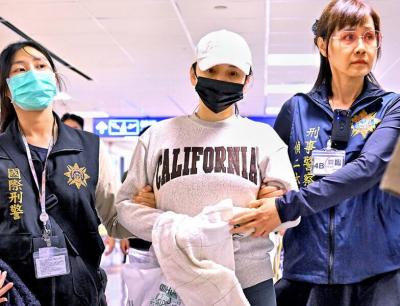
Johanne Liou (劉喬安), a Taiwanese woman who shot to unwanted fame during the Sunflower movement protests in 2014, returned to Taiwan last night after being deported from the US. She is to stand trial in Taiwan for charges involving embezzlement, fraud and drug crimes. The Criminal Investigation Bureau (CIB) said it took her into custody at Taiwan Taoyuan International Airport and would first question her before transferring her to the New Taipei District Prosecutors’ Office. She was arrested upon disembarking a flight from San Francisco that landed shortly before 7pm. Liou absconded to the US in 2019 after jumping bail


 RSS
RSS